
Setting Up Chart of Accounts for 3P Financial Reconciliation
Accurate financial reconciliation with third-party (3P) delivery platforms requires precise mapping of every transaction type to your Chart of Accounts (COA). This guide walks through the categories Loop will reconcile, and the GL accounts we recommend mapping each one to.
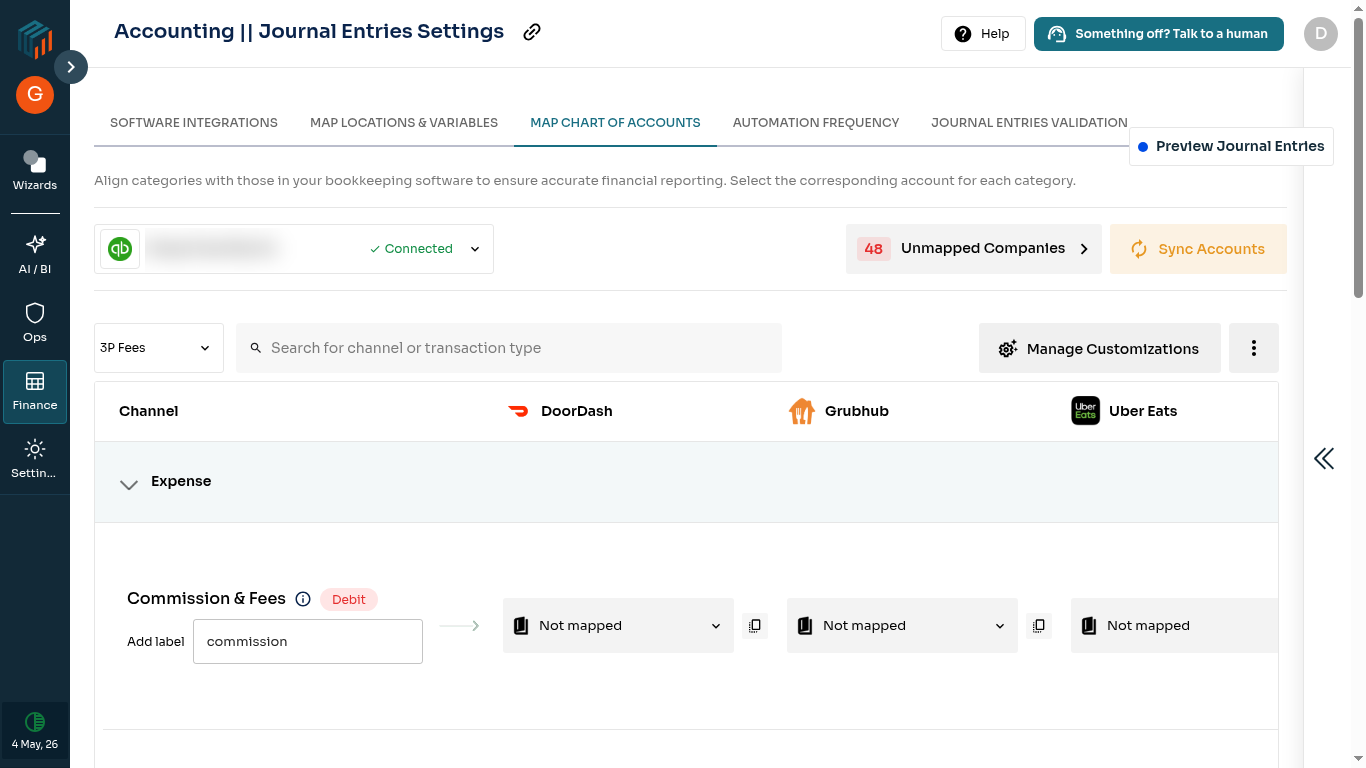
The page is organized into Channels (DoorDash, Grubhub, Uber Eats, ezCater, etc.) along the top, and collapsible sections (Expense, Income, etc.) down the page. Use the JE Type dropdown in the top-left of the table to switch between two category groups:
- 3P Fees — the standard mappings: sales, fees, payouts, taxes, tips, refunds, marketing, etc. Use this for sections 1–9 below.
- Variance — mappings used only when your POS is also posting sales / tax / commission and Loop needs to capture the difference between POS-reported and marketplace-reported amounts. The POS-specific categories at the end of this article live under the Variance JE Type.
Tabs across the top of Journal Entries Settings
- SOFTWARE INTEGRATIONS — connect QuickBooks, NetSuite, Sage Intacct, Restaurant365, etc. (Old "Integration Settings" is now part of this tab.)
- MAP LOCATIONS & VARIABLES — map Loop locations to your accounting-software entities. (Renamed from "MAP LOCATIONS".)
- MAP CHART OF ACCOUNTS — this article.
- AUTOMATION FREQUENCY — how often Loop posts journal entries. (Renamed from "CADENCES".)
- JOURNAL ENTRIES VALIDATION — new tab; preview JEs before they post.
Handling 3P Adjustments & Fees
1. A/R Adjustments
Balances journal entries when sales and payouts haven't been posted yet (debits and credits stay aligned). Not necessary if every Loop category is mapped into your chart of accounts. Map to either:
- Accounts Receivable Adjustment account, or
- A separate Loop Over/Short account if you want to track Loop-specific reconciliation deltas.
2. Customer Refunds & Won Disputes
Customer Refunds — chargebacks and customer-initiated refunds (order issues, cancellations). Map to:
- Your Sales Adjustment account, or
- A dedicated Customer Refunds account.
Won Disputes — refunds that were initially disputed and later recovered. Map to:
- Your Sales Adjustment account, or
- A dedicated Customer Refunds / Won Disputes account.
3. Miscellaneous Fees
Fees the marketplace labels as "miscellaneous." Map to:
- The same fee account as Delivery Fees (simplest), or
- A dedicated Miscellaneous Fees account if you want them tracked separately.
4. Unaccounted Transactions
Non-identifiable line items, e.g. rounding errors. Map to:
- The same fee account as Delivery Fees,
- A dedicated Unaccounted Expense account, or
- An Over and Short account.
5. Commissions
Fees charged by delivery providers for order facilitation and delivery. Map to a dedicated Delivery Fee account.
6. Marketing Spend
Variable campaign and promotional expenses. Loop separates these into two sub-categories:
- Marketing Ad Spend — expenses for online ads, banners, etc.
- Marketing Promo Spend — costs of promotional discounts (e.g. "buy one, get one free").
Choose one of:
- A single parent Marketing Spend GL account,
- Separate GL codes for Ad and Promo spend, or
- One GL with separate line-item labels.
Recommendation: keep Marketing and Commissions in different GL accounts so spend analysis stays clean.
7. Net Payout
The net amount the marketplace deposits after all deductions. Map to your Bank Deposits or Undeposited Funds account.
Handling 3P Sales & Taxes
1. Customer Tips
Tips collected for store team members and credited to the payout. Map to your Tips Payable account.
If your POS already posts tips, leave this unmapped to avoid double-counting. Contact the marketplace if tips appear here unexpectedly.
2. Sales (Excluding Tax)
Total sales before taxes. Map to your Sales Revenue account, ideally one per delivery partner so revenue can be sliced by channel.
Leave unmapped if your POS already posts marketplace sales.
3. Taxes
Sales taxes collected for tax authorities. Map to Sales Tax Payable.
Leave unmapped if your POS already posts taxes.
4. Taxes Withheld (Credit)
Taxes the marketplace remits directly under marketplace facilitator tax (MFT) rules. If you want to track them, map to a Sales Tax Non-Payable / MFT account.
Leave unmapped if your POS already excludes MFT from tax liability.
5. Taxes Withheld (Debit)
The offsetting entry that adjusts your tax liability when MFT is withheld. Map to a Tax Liability account if your POS posts MFT as a liability without distinguishing different tax types.
If you're unsure how your POS handles MFT, reach out to your Loop Balance contact or support@tryloop.ai — we'll recommend a setup that matches your books.
Handling POS-Specific Adjustments (Variance JE Type)
The categories below appear only when you switch the JE Type dropdown at the top-left of the table from 3P Fees to Variance. Variance journal entries separate POS-vs-marketplace differences into their own JE so the accrued and actual amounts are clearly captured.
1. POS Subtotal Variance
Tracks variance between POS-reported sales and marketplace-reported sales for the period. Map to Sales Revenue — one account per delivery partner.
2. POS Tax
Tracks variance between POS-reported tax and marketplace-reported tax for the period. Map to your Sales Tax account.
3. POS Commission
Tracks variance between POS-reported commissions and marketplace-reported commissions for the period. Map to a dedicated Delivery Fee account.
Customizing per Location, Brand, or State
The default mapping applies across your whole org. To override mappings for specific locations, brands, or states, use the Manage Customizations button on the right side of the page header.
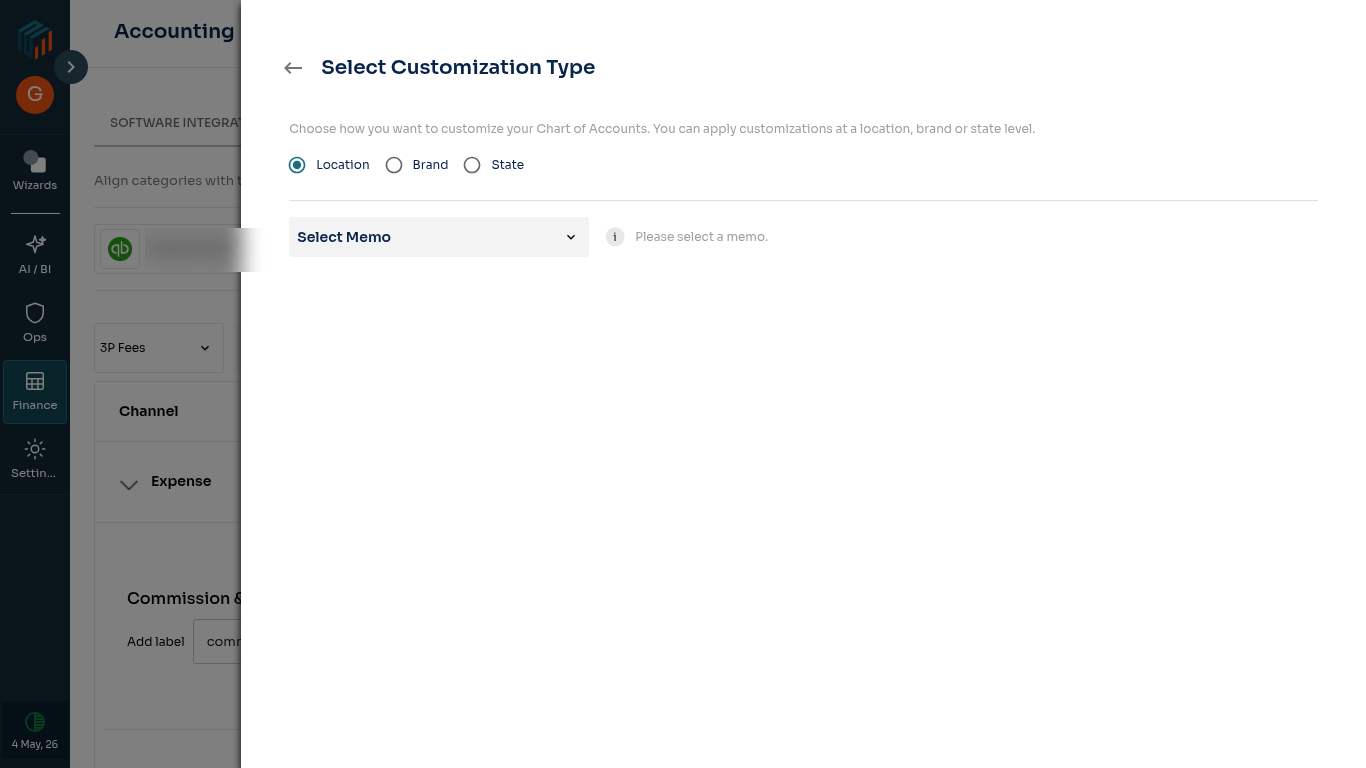
- Click Manage Customizations.
- In the Select Customization Type drawer, choose the scope: Location, Brand, or State.
- Pick the memo (transaction category) you want to override — e.g. Net Payout, Commission, Sales Revenue.
- Set the GL code for each location / brand / state under the customization. Leave others on the default to inherit the org-wide mapping.
- Click Save Mappings.
After mapping, verify your setup
Once mappings are saved:
- Click Sync Accounts in the page header to pull the latest GL codes from your accounting software (QuickBooks, Sage Intacct, Restaurant365, NetSuite, etc.).
- Switch to the JOURNAL ENTRIES VALIDATION tab to preview the entries Loop will push for a given period before they hit your books.
- Resolve any Unmapped Companies (badge in the page header) before pushing journal entries.
Need help?
If you have any questions or need help with the integration, please reach out to support@tryloop.ai.